Trier et jeter ses ordures en Corée : guide étape par étape pour étrangers (2026)

The Shared Homies Team
Shared Homies
Publié le 28 avril 2026 · Dernière mise à jour 28 avril 2026
TL;DR
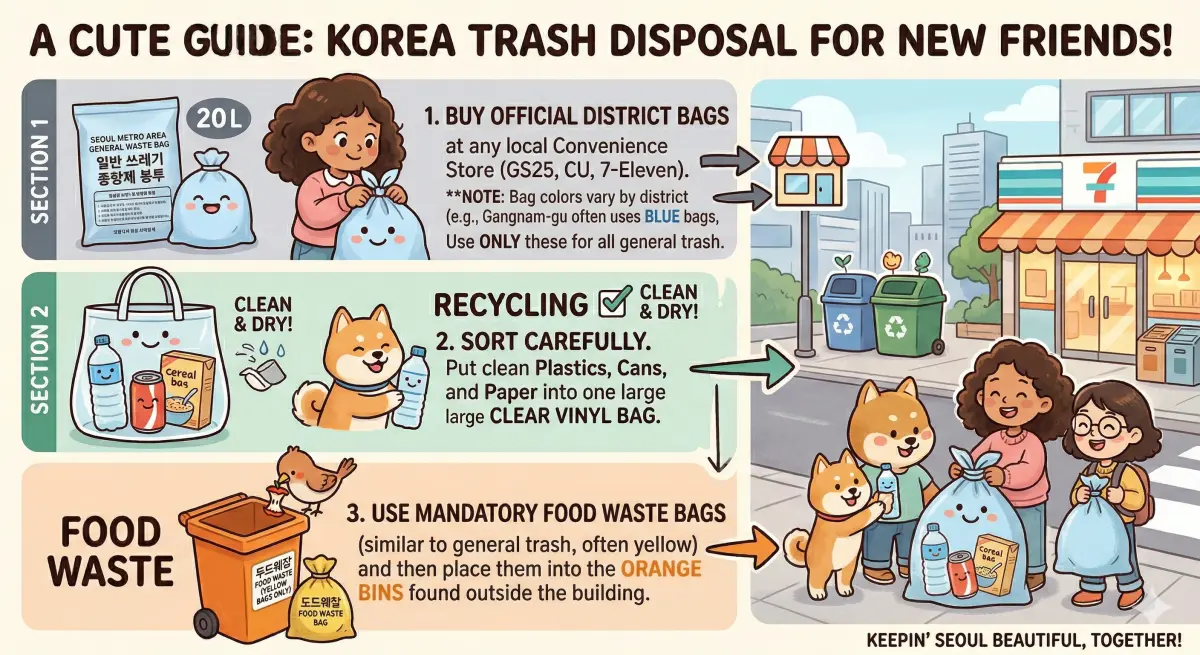
- La Corée utilise la 종량제 — des sacs officiels spécifiques au district achetés dans n'importe quelle épicerie de proximité.
- Un sac de 20 L pour déchets généraux coûte environ ₩490 à Séoul ; les tailles vont de 5 L à 100 L.
- Le plastique, le verre, le papier, le carton et le métal se trient séparément — propres et secs.
- Les déchets alimentaires vont dans des sacs jaunes dédiés ou dans des bacs pesés par puce RFID ; les congeler évite les odeurs.
- Les amendes pour mauvais sac commencent à ₩100 000 et atteignent ₩1 000 000 en cas de récidive.
Frequently asked questions
Jongnyangje literally translates to 'volume-rate system.' Korea charges for general household waste based on how much you throw away — and you pay by buying official district-issued bags. The bag price is the disposal fee. Recycling and food waste have their own separate streams. The system was rolled out nationwide in 1995 to incentivize waste reduction, and Korea now recycles roughly 60% of municipal waste — among the highest rates globally per the [Wikipedia summary on Recycling in South Korea](https://en.wikipedia.org/wiki/Recycling_in_South_Korea).
Any convenience store in your neighborhood — GS25, CU, 7-Eleven, Emart24 — sells the official bags for that exact district. Walk in, point to the wall behind the cashier (bags are usually displayed there or kept under the counter), and say 종량제 봉투 (jongnyangje bongtu). Add the size you want — 10리터 (10 liters), 20리터 (20 liters), 50리터 (50 liters). The cashier scans the bag, you pay, you walk out. No ID, no ARC, no Korean fluency needed.
Legally no. Each district (gu / 구) issues its own bags, and the disposal fee is collected by that district. A Mapo-gu bag set out in Gangnam-gu is treated as illegal disposal — collection workers will leave it on the street with a violation sticker, and CCTV-confirmed cases trigger fines starting at ₩100,000. If you're staying with a friend overnight, give them the bag of trash and let them dispose with their building's correct local bag.
Korea's rule of thumb: if an animal could eat it, it's food waste. If not, it's general waste. Eggshells, chicken bones, fish bones, large fruit pits, shellfish shells, and crustacean shells go in general waste — not food waste — because they can't be processed into animal feed. Tea bags (the bag itself), coffee filters, toothpicks, and cooking-oil-soaked items also go in general waste. Soft fruit peels, vegetable trimmings, leftover rice, leftover meat, and most cooked food go in food waste.
Yes — it's the most-recommended apartment-living tip in Korea, especially for summer (June–September) when food waste smells become unmanageable within hours. Freezing pauses bacterial decomposition, kills odor before it forms, and keeps fruit flies away entirely. Use a small lidded container or a sealed ziplock dedicated to food scraps — most Koreans keep one on the freezer's bottom shelf. On disposal day, transfer the frozen contents into your food waste bag or RFID bin. The frozen waste also weighs less moisture-wise, which lowers the per-kilo charge in RFID buildings.
Most Seoul districts allow disposal between sunset and midnight on the night before your collection day, with collection happening early the next morning. Specific timing is set by each gu and posted at your building or on its website. Putting trash out outside that window — too early, on the wrong day, or in the morning of collection — triggers fines starting at ₩100,000. Co-living and serviced apartment operators (including [Shared Homies](/houses)) typically handle the timing for residents and just ask you to stage your bags inside the building.
Large items can't go in regular bags — you have to register them and buy a disposal sticker (대형폐기물 처리 스티커) before setting them out. Most districts let you register online via the gu website or via an app called 빼기 (Ppaegi). Sticker fees range from ₩2,000 (small chair) to ₩30,000+ (king-size mattress). For large electronics — fridges, washing machines, TVs over a meter — call the free government collection service at 1599-0903 or visit [15990903.or.kr](https://15990903.or.kr/). They schedule a pickup and take it for free, provided the unit is intact.
Foreigners are subject to the same waste laws as Korean residents. CCTV monitoring is widespread, especially in dense neighborhoods like Itaewon, Hongdae, and Gangnam. First-offense fines for wrong-bag or out-of-window disposal typically run ₩100,000. Mixing food waste into general trash carries fines up to ₩300,000 per the Wastes Control Act. Repeat offenders can be fined up to ₩1,000,000. That said, building managers and 구청 staff often issue a verbal warning for first-time confused foreigners — the system is strict on paper but practically forgiving for people clearly trying to comply.

The Shared Homies Team
Shared Homies
A team of foreigners and Koreans operating shared homes across Seoul. We write what we learn from running a co-living business for international tenants.